
Shipping from Malaysia to Singapore often looks straightforward. Yet once businesses start comparing air, sea, and cross-border trucking, the differences in transit time, handling, and cost behaviour become more significant than expected.
While each mode uses the same border, the way shipments are consolidated, cleared, and delivered can lead to very different outcomes. For B2B freight that moves at pallet scale, cross-border trucking is often the most practical option.
#1. Trucking from Malaysia to Singapore: What It Is
Cross-border trucking from Malaysia to Singapore moves palletised commercial freight from major hubs such as Kuala Lumpur, Johor Bahru, and Penang directly into Singapore using scheduled trucks.
This mode relies on road transport across a single land crossing between both countries, offering a balance of speed and cost for businesses shipping regularly.
Cargo moves in commercial vehicles with the required customs documentation, permits, and clearance for cross-border movement, making it suitable for repeat B2B shipments and restocks.
#2. How Trucking from Malaysia to Singapore Works (Step by Step)
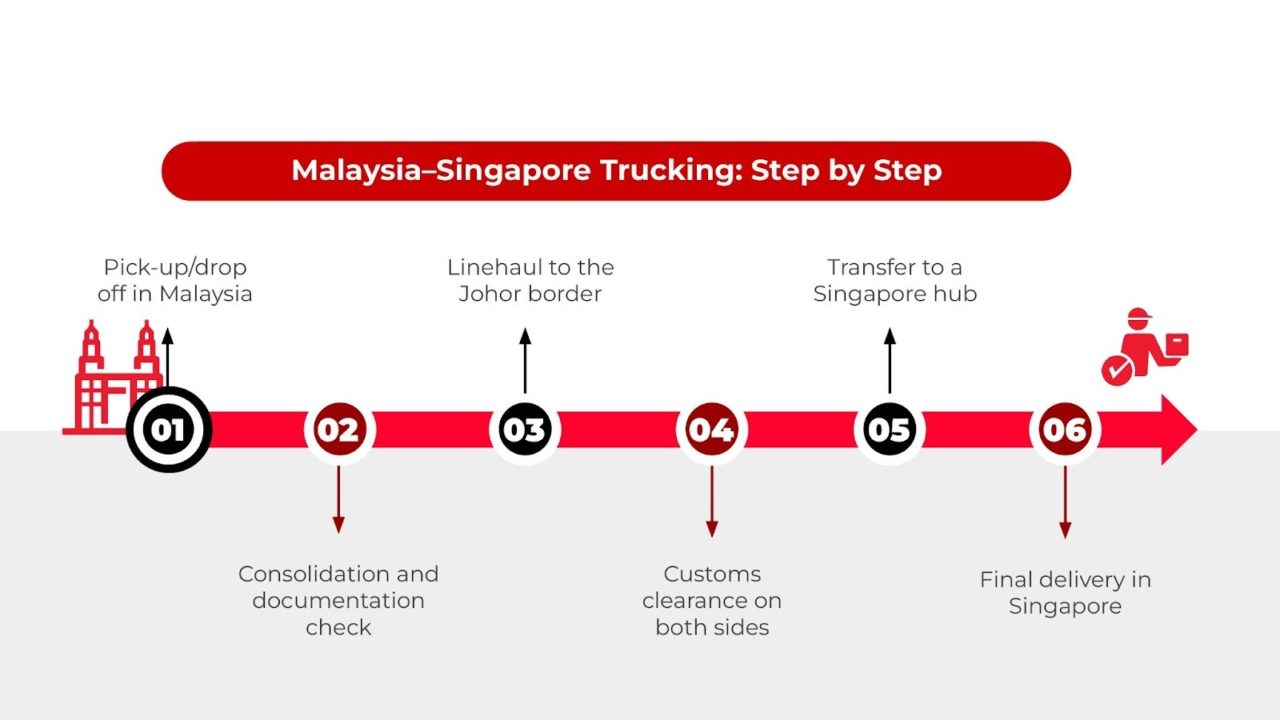
1. Pickup or drop off in Malaysia
Shipments are collected from the shipper or received at a designated Malaysia hub.
2. Consolidation and documentation check
Goods are grouped, packed and prepared with the required customs paperwork.
3. Linehaul to the Johor border
Shipments are loaded into scheduled trucks and transported to the Causeway or Tuas checkpoint.
4. Customs clearance on both sides
Drivers submit manifests and documents to Malaysian and Singaporean authorities for inspection and approval.
5. Transfer to a Singapore hub
Once cleared, goods are moved into a Singapore distribution hub for sorting.
6. Final delivery in Singapore
Shipments are handed over to local couriers or transporters for last-mile delivery.
#3. Air, Sea, and Trucking Compared
Choosing the right way to ship from Malaysia to Singapore usually comes down to three main options: air freight, sea freight and cross-border trucking.
Each mode uses the same border but handles cost, transit, and cargo very differently. The table below gives a quick overview before we explore when trucking becomes the best choice.
| Mode | Delivery Time | Cost | Best For |
| Air Freight | 1 – 2 days | Highest cost per kg | Urgent, high-value, time-sensitive items |
| Sea Freight | 5 – 10 days | Lowest cost per kg for large volumes | Large, planned stock moves and pallets |
| Cross-Border Trucking | 2 – 5 days | Balanced cost and speed for pallets | Regular restocks and routine B2B freight |
For palletised freight that is too heavy for air to make sense but too time-sensitive for sea, trucking often becomes the preferred option.
#4. When Trucking Becomes the Best Option
On the Malaysia–Singapore lane, cross-border trucking typically works best once shipments are consolidated into pallets and moved as commercial freight.
It is especially suitable when:
- Shipments are palletised and move regularly
- Businesses restock Singapore on a weekly or monthly cadence
- Delivery is needed within a few days, without paying air freight premiums
Rather than thinking in terms of cartons or kilograms, trucking decisions are usually clearer when planned around pallet count and truck space.
5. Documentation Checklist for Trucking from Malaysia to Singapore
Finally, getting paperwork right is just as important as choosing the right mode. Here is a simple checklist of documents commonly needed for cross-border trucking from Malaysia to Singapore.
| Category | Documents | Purpose |
| Basic shipping documents | Commercial invoice, packing list, shipper, and consignee details | Tell customs and carriers what you are shipping, who it is for and what it is worth. |
| Customs and compliance | HS codes, permits or licences for controlled goods, relevant tax or registration details | Make sure the goods are classified correctly and meet Malaysia and Singapore import rules. |
| Transport documents | Consignment note or waybill, delivery address and unloading instructions for the Singapore receiver | Help your trucking provider plan loading, routing and a smooth handover at the Singapore destination. |
Looking for a Reliable Cross-Border Trucking Partner?
Ninja Van has over a decade of operating experience in both Malaysia and Singapore, making this corridor one of our strongest and most mature lanes. Our long-standing routes and carrier partnerships allow us to offer reliable schedules and trucking rates that are consistently lower than typical market pricing.
If you need a cost-effective cross-border solution, our team can support you end-to-end.
Contact Ninja Freight today.